Should I Take A Pill or Patch for Birth Control?
Picking a birth control is often a difficult decision, as there are so many options available. However, these options allows you to find the perfect contraception to fit your specific needs. Some people prefer taking oral medications, while others may prefer longer-acting methods that don’t require swallowing pills.
How Does the Menstrual Cycle Work?
The menstrual cycle is a natural process that occurs in the female reproductive system. It involves a series of hormonal and physiological changes that prepare the body for potential pregnancy.
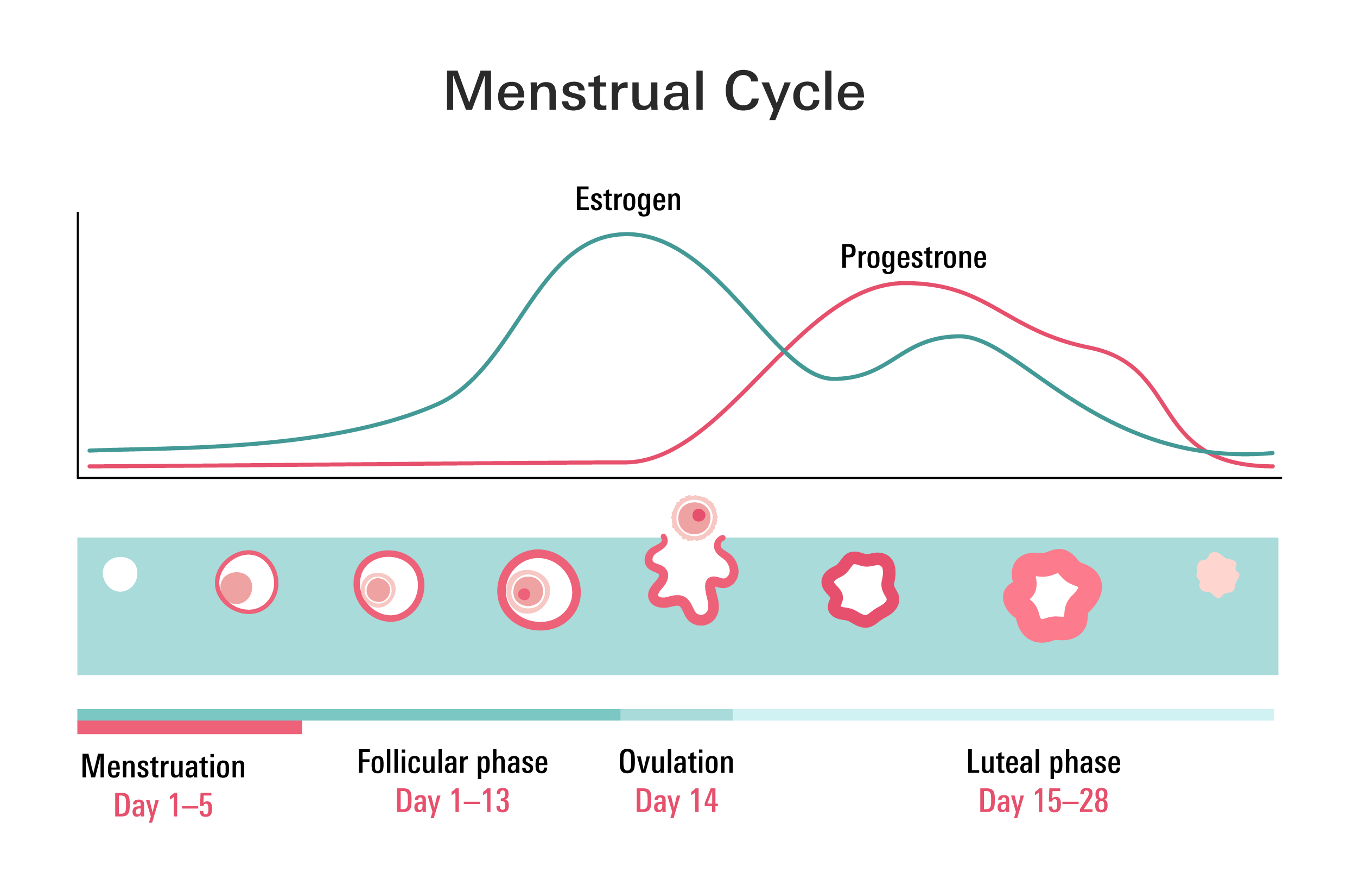
The “sex hormones” involved in this cycle are estrogen and progesterone. Estrogen levels peak at day 12/13 to cause ovulation to occur. Progesterone levels follow, rising following ovulation and falling again before menstruation.
This typically occurs over a period of 28 days but can vary anywhere from a 21 to 36-days. This cycle is divided into four key phases:
- Menstruation (the peirod)—Day 1–5 : This is marked by the shedding of the uterine lining (endometrium) and the release of blood through the vagina. This occurs alongside a drop in both estrogen and progesterone.
- Follicular Phase—Day 1–14: It begins on the first day of menstruation and lasts for 13 to 14 days, marks the start of the menstrual cycle and ends with ovulation. This is when an egg matures in the ovaries, alongside a rise in estrogen.
- Ovulatory—Day 14: A mature egg is released from the ovary (ovulation). This typically occurs on day 14 following the peak in estrogen levels.
- Luteal Phase—Day 15–28: This final stage occurs from day 15-28 as the lining of the uterus thickens to prepare for pregnancy. Progesterone peaks, then both estrogen and projesterone decrease back to baseline by the end of the phase to preprare for menstruation.
How Does Hormonal Birth Control Work?
Birth control targets one or multiple phases of the menstrual cycle to prevent pregnancy. By supplying synthetic hormones to the body, birth control prevents the hormonal fluctuations responsible for certain parts of the menstrual cycle. The two main hormones used are synthetic estrogens and progesterone (progestin).
Birth controll pills work by
- suppressing ovulation
- thickening of cervical mucus, making it difficult for sperm to penetrate and reach the egg
- thinning of the endometrium (the uterine lining), making it less receptive to the implantation of a fertilized egg
Many birth control forms use a combination of estrogen and progestin, while others use progestin alone. The two common products for the combination method are the combination patch and the combination pill.
Differences Between the Patch and the Pill
Both methods are hormonal contraceptives and work in similar ways by delivering synthetic hormones (usually a combination of estrogen and progestin) to prevent pregnancy. The main difference is the methods of delivery.
Birth control pills are taken orally, usually once a day at the same time for 21 days. On the other hand, patches are applied topically to the skin and replaced once a week for 3 weeks. Instead of being ingested, the hormones are absorbed slowly through your skin.
The daily dose of each hormone is similar in both options, but the exposure is different. Since the patch goes right through the skin into the blood, the exposure tends to be a little higher than with the pill which gets absorbed through the gut before getting to your blood.
Both methods of birth control are very effective, though there is the chance of user error, such as forgetting to take a pill or apply a new patch. From typical to perfect use, both methods of birth control can be anywhere from 91 to over 99% effective.
Which is More Convenient?
This depends on your personal preferences, as each method has its pros and cons.
Combination pills are typically taken orally on a daily basis. They are usually taken daily for 21 or 28 days, followed by a break or a week of placebo pills for a "period". While there is some “wiggle room” with timing, you should take your pill at roughly the same time every day in order for them to be most effective.
On the other hand, patches are applied topically to your skin and replace weekly. You stick one patch on your skin for 7 days. After a week, you take the old patch off and replace it with a new one. This typically occurs for three weeks, before taking one week off for a “period”.
Some individuals prefer the patch for its convenience. This is ideal for individuals who may struggle with taking medication at a consistent time each day. Others may prefer the pill because they don’t like having the patch constantly on their body. The patches shouldn’t interfere with day-to-day activities such as showering or exercise, but they are in view, applied on the arm or stomach. They may be in view in pictures or events. Therefore, the pill may be the preferred option if you desire discretion with your contraception.
Comparing Who Can Take the Patch or Pill
For most individuals, both types of contraception are safe. However, certain populations are recommended to avoid taking any combination contraceptives. This means you would not be able to use either the pill or the patch.
Do not take combination contraceptives if you:
- are pregnant
- are within 6 weeks of delivery
- are older than 35 and smoke
- have uncontrolled high blood pressure or diabetes
- have history of a blood clot
- have heart disease
- have migraines with aura
- have active liver disease
- have vaginal bleeding from unknown cause
The patch is likely not safe and/or not effective if you
- weight more than 90kg (198lb)
- take medications for hepatitis C
The pill may not be safe if you
- have kidney impairment
- have issues with your adrenal gland
It is important to speak with your healthcare provider about your personal medical history in order to determine which, if either, birth control method may be best for you.
Side Effects
Most side effects from birth control are due to the hormones contained in the medications. Because of this, both forms have similar side effects. T
The side effects for both include:
- Nausea
- Headache
- Breast tenderness/discomfort
- Irregular periods/spotting
- Mood changes
Since the exposure to hormone tends to be higher for the patch, the side effects are often slightly stronger for this form. There tends to be more incidence of breast tenderness with the patch. Additionally, you could experience application site reactions, such as redness and burning at the site.
Cost
In general, the birth control patch tends to be slightly more expensive than the pills. This is often true for longer-acting products, including patches, injectable or implantable birth control methods. While a 28-day pack of birth control pills costs approximately $20, cost for a month-supply of the patch is closer to $50.
Which One Is Better?
This question would have a different answer depending on your own personal preferences. However, there are a number of things to consider, which are outlined here.
| Combination pill | Combination patch | |
| Indications | Not recommended if you:
|
Not recommended if you:
|
| Effectiveness | 91 to >99% effective | 91 to >99% effective |
| Side effects | Most common with the pill:
|
Most common with the patch:
|
| Administration |
|
|
| Cost at Marley Drug | $20 per 28-day pack | $50 per 28-day pack (3 patches) |
Prices mentioned in this article are based on average retail price at major box chain pharmacy in the U.S. as of May 31, 2023.
References:
- Galzote, R. M., Rafie, S., Teal, R., & Mody, S. K. (2017). Transdermal delivery of combined hormonal contraception: a review of the current literature. International journal of women's health, 9, 315–321. https://doi.org/10.2147/IJWH.S102306
- NHS. (2020, April 17). How effective is contraception at preventing pregnancy?. NHS choices. Retrieved May 12, 2023, from https://www.nhs.uk
- Contraindications to the OCP. The Royal Children’s Hospital Melbourne. (n.d.). Retrieved May 12, 2023, from https://www.rch.org.au
- Mayo Foundation for Medical Education and Research. (2023, February 9). Birth control patch. Mayo Clinic. Retrieved May 12, 2023, from https://www.mayoclinic.org
- Xulanegeneric Ortho Evra. GoodRx. (n.d.). Retrieved May 12, 2023, https://www.goodrx.com
- Generic Yaz. GoodRx. (n.d.). Retrieved May 12, 2023, https://www.goodrx.com
- TWIRLA (levonorgestrel and ethinyl estradiol) transdermal system – Access data FDA-Approved Drugs [Internet]. [amended 02/2020; accessed 05/2023].
- YAZ (drospirenone/ethinyl estradiol) – Access data FDA-Approved Drugs [Internet]. [amended 04/2012; accessed 05/2023].