



What To Do When You Miss A Birth Control Pill
Staying consistent with your birth control method is essential for pregnancy prevention. Many types of birth control rely on you to take certain actions, like remembering to take a daily pill or changing a patch every week. However, life can sometimes throw us unexpected surprises, leading to a missed dose or displacement of your contraception. This often leads to the common question: What should I do?
To respond appropriately, it’s important to understand specifics of each birth control method. In this blog, we will cover three common methods: pills, patches, and intravaginal rings. Each method has its own considerations and guidelines for handling missed doses or displacement.
How Each Method Works
Pills
Birth control pills contain synthetic estrogen and progesterone. They are taken orally and work by regulating hormone levels in the body to prevent ovulation and thicken the cervical mucus, making it difficult for sperm to reach the egg.
Patches
Birth control patches deliver a combination of hormones (estrogen and progestin) through the skin. The hormones are absorbed into the bloodstream and work in a similar way to birth control pills, preventing ovulation and altering the cervical mucus to inhibit fertilization.
Rings
Intravaginal rings are inserted into the vagina and release a combination of hormones directly through the vaginal wall. The hormones are slowly absorbed into the bloodstream, providing continuous contraception by suppressing ovulation and thickening cervical mucus.
Read about Types of Birth Control
Missing a pill
If you are taking birth control pills, which come in two types (combination pills and progestin-only pills), your response to missing a pill(s) depends on the type you are using.
Combination pills
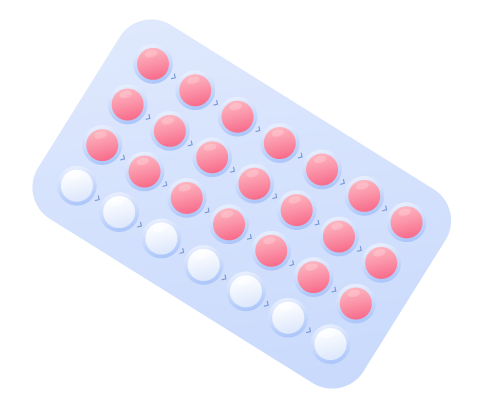
Combination pills contain synthetic forms of estrogen and progesterone, closely mimicking your natural menstrual cycle. The hormone contents vary between week 1 and weeks 2 & 3.
Week 1: missing 1 or more pills
- Take the missed pill as soon as possible, even if it means taking two pills in one day
- Continue taking the remaining pills as scheduled
- Use a backup contraceptive method, such as condoms
Starting your birth control pack late after the hormone-free period (such as starting on day 2 or 3) still counts as a missed pill during week 1!
Week 2 and 3: missing 2 pills
- Take the last pill you missed, even if it means taking two pills at once
- Skip the hormone-free week and proceed to the next pack without taking a break
- No need to use a backup contraceptive method in this case
Week 2 and 3: missing 3 or more pills
- Take the one missed pill as soon as possible
- Skip the hormone-free week and begin the next pack immediately after finishing the current pack
- Use backup contraceptives for the following 7 days
Progestin-only pills (Minipills)
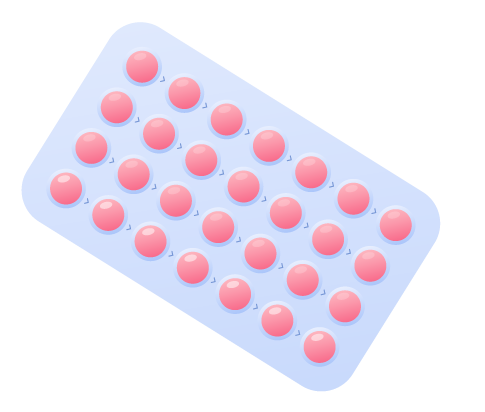
Progestin-only pills, as the name suggests, do not contain estrogen and only contain synthetic progesterone. They differ from combination pills in two main ways:
- Administration Window: Progestin-only pills must be taken within a 3-hour window every day, which is shorter than the timeframe for combination pills.
- No Hormone-Free Period: Progestin-only pills are taken every day throughout the 28-day cycle, with no placebo pills. This means there is no break between packs.
For progestin-only pills, the 3-hour window is crucial. If you miss the pill by more than 3 hours, follow these steps:
- Take the missed pill as soon as possible
- Use a backup contraceptive method, such as condoms, for the next 2 days
What if Your Patch Falls Off?
Patches are combination contraceptives that follow a 28-day cycle. Each pack contains 3 patches, with one patch applied per week and a patch-free fourth week. Although patches are water-resistant, they can sometimes fall off. Here's what to do in that situation:

Any week: the patch has fallen out for less than 24 hours
- Reapply the same patch or a new one as soon as possible
- Continue changing the patch on your normal change day
- Maintain the hormone-free interval as scheduled
- No backup contraception is required
Week 1: the patch has fallen out for more than 24 hours
- Apply a new patch as soon as possible
- Change the patch on your normal change day
- Do not skip the hormone-free week
- Use backup contraception for the next 7 days
Week 2 and 3: the patch has fallen out for less than 72 hours
- Apply a new patch as soon as possible
- Change the patch on your normal change day
- Skip the hormone-free week
- No backup contraception is necessary
Week 2 and 3: the patch has been off for longer than 72 hours
- Apply a new patch
- Change the patch on your normal change day
- Skip the hormone-free week
- Use backup contraception for the next 7 days
What to Do if Your Intravaginal Ring Falls Out?
The intravaginal ring is a contraceptive method that you insert into your vagina. It contains a combination of synthetic estrogen and progestin and is packed into a small, flexible plastic ring. Similar to the patch, the ring operates on a 28-day cycle. You insert one ring each week for weeks 1-3 and have a ring-free fourth week.

Here are the steps to follow if your intravaginal ring falls out:
Any week: the ring has fallen out for less than 3 hours
- Reinsert it as soon as possible
- Change the ring on your normal change day
- Maintain the hormone-free interval as scheduled
- No backup contraception is required
Week 1: the ring has fallen out for more than 3 hours
- Reinsert it as soon as possible
- Change the ring on your normal change day
- Keep the hormone-free week as planned
- Use backup contraception for the next 7 days
Week 2 and 3: the ring has fallen out for less than 72 hours
- Reinsert it as soon as possible
- Change the ring on your normal change day
- Skip the hormone-free week and start the next cycle immediately
- No backup contraception is necessary
Week 2 and 3: the ring has fallen out for longer than 72 hours
- Reinsert it as soon as possible
- Change the ring on your normal change day
- Skip the hormone-free week and start the next cycle immediately
- Use backup contraception for the next 7 days
Summary
Missing a birth control pill can happen to anyone, but it's essential to know how to handle the situation correctly. By following the appropriate steps based on the type of birth control method you are using, you can help maintain the effectiveness of your contraception and reduce the risk of unintended pregnancy.
Always keep in mind that the information provided in this blog post serves as a general guide and may not cover all possible scenarios or variations in birth control methods. Consult your healthcare provider or refer to the specific instructions provided with your chosen method for personalized advice.
References:
- Guilbert, E., Black, A., Dunn, S., Senikas, V., MEDICAL EXPERTS IN FAMILY PLANNING OF THE NATIONAL INSTITUTE OF PUBLIC HEALTH OF QUEBEC, & SOCIAL AND SEXUAL ISSUES COMMITTEE (2008). Missed hormonal contraceptives: new recommendations. Journal of obstetrics and gynaecology Canada: JOGC = Journal d'obstetrique et gynecologie du Canada: JOGC, 30(11), 1050–1062. https://doi.org/10.1016/S1701-2163(16)33001-8
- Cornell University. (2022, November). Missed a Birth Control Pill? Here’s what to do. Cornell Health. Retrieved June 1, 2023, from https://health.cornell.edu
- NHS. (2019, August 06). What should I do if I mis a pill (progesterone-only pill)?: Your contraception guide. NHS Health A-Z. Retrieved June 1, 2023, https://www.nhs.uk
- NHS. (2021, July 06). Vaginal Ring: Your contraception guide. NHS Health A-Z. Retrieved June 1, 2023, https://www.nhs.uk
- NHS. (2021, July 06). Vaginal Ring: Your contraception guide. NHS Health A-Z. Retrieved June 1, 2023, https://www.nhs.uk

