


Why Menopause Treatment Usually Includes Progesterone, Not Just Estrogen
If you recently spoke to your healthcare provider about hormone therapy to help with menopause symptoms you may have left your appointment with not just one prescription, but two. It is very common to wonder why you should take progesterone with estrogen when you are simply looking to relieve your menopause hot flashes or night sweats. This guide will help explain the reason for two different hormone prescriptions, what progesterone does inside the body and who may or may not need it. If you are looking to learn more about the basics of menopause and the resulting hormone changes, feel free to explore our educational menopause guide.
What Estrogen Does to the Uterine Lining When it is Given on Its Own
During menopause, the body faces hormonal imbalances when it slowly stops producing progesterone and estrogen. Supplementing estrogen during menopause allows you to ease the imbalances and menopause symptoms such as hot flashes and night sweats. Estrogen can be very effective at relieving these menopause symptoms but when given on its own it causes the uterine lining to grow and thicken. When estrogen is given on its own, the uterine lining growth can be continuous and over time may lead to a condition called endometrial hyperplasia.
What is Endometrial Hyperplasia?
Endometrial hyperplasia is a medical condition where the uterine lining becomes abnormally thick and significantly increases the risk of endometrial (uterine) cancer. You are more likely to experience endometrial hyperplasia if you have prolonged estrogen exposure without enough progesterone to balance it.
Why Do I Need Progesterone If I’m Taking Estrogen?
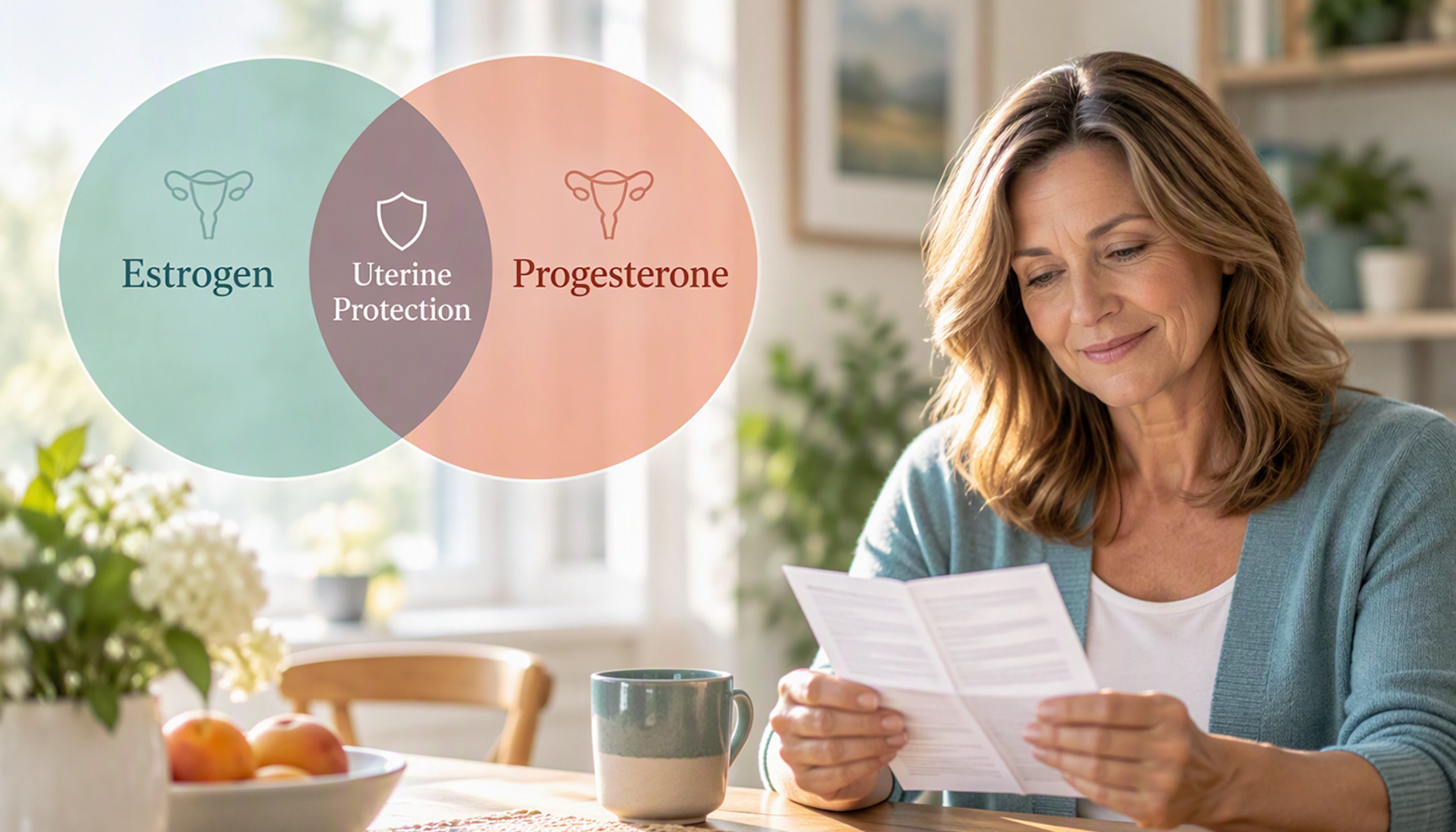
The number one reason a healthcare provider will prescribe progesterone with estrogen during menopause is to protect the lining of your uterus. Estrogen hormonal therapy causes the uterine lining to thicken and build up, while progesterone helps reverse this. Progesterone stops the uterine cells from overgrowing and helps the body keep a thin and healthy uterine lining. By taking both progesterone and estrogen your body is able to balance the effects on the uterus lining and lower your risk of developing uterine hyperplasia and endometrial (uterine) cancer.
What Does Progesterone Do for the Uterus?
Progesterone helps alter the tissues of the endometrial lining inside the uterus so that it remains stable instead of in a growing phase that is seen when only estrogen is taken. Depending on how your healthcare provider prescribes your medication, progesterone can either cause the lining to shed regularly and similar to a light period or may keep the uterine lining continuously thin so it does not build up and shed at all.
Do I Need Progesterone If I’ve Had a Hysterectomy?
A hysterectomy is a surgery to remove the uterus. Most individuals who have had a hysterectomy do not need to take progesterone with estrogen. In menopause, the main purpose of taking progesterone hormonal therapy is to protect the uterine lining. However, when the uterus is removed it eliminates this specific risk and estrogen can usually be taken on its own. There are still rare exceptions where a healthcare provider may still recommend both estrogen and progesterone such as a patient with a history of severe endometriosis so it is important to speak with your provider before making any changes or decisions about your therapy.
Is Micronized Progesterone the Same as a Progestin?
Often these terms are used interchangeably but micronized progesterone and synthetic progestins are actually different molecules with distinct properties.
- Micronized Progesterone
Micronized progesterone is chemically identical to the progesterone produced by the body’s ovaries.
- Progestin
Progestins are laboratory created compounds designed to mimic progesterone in the uterus.
Examples include:- Norethindrone
- Medroxyprogesterone acetate (MPA)
- Levonorgestrel
Both micronized progesterone and progestins are effective at protecting the uterine lining. Your healthcare provider will choose the option that best meets your medical history and health goals.
Click to view our oral micronized progesterone capsules available online.
Why Menopause Therapy Regimens Differ from Person to Person
Each person experiences menopause in a different way which is why your healthcare provider must customize your hormone therapy and duration to meet your needs. There are two main ways that progesterone is taken with estrogen:
- Cyclic Regimen: Estrogen is taken every day. Progesterone is taken for a set number of days each month, most often 12-14 days in a row then stopped for the remaining days of the month. This usually creates a predictable period-like withdrawal bleed each month.
- Continuous Regimen: Both estrogen and progesterone are taken together every single day. This usually prevents monthly bleeding altogether.
Understanding the Boxed Warning and How to Think About It
Like all hormone therapy medicines, oral micronized progesterone capsules come with important safety warnings. These warnings include potential risks related to hormone replacement therapy, such as blood clots, stroke, heart conditions, and breast cancer. Many of these warnings stem from older studies, like the Women's Health Initiative, which tested different progestin hormones rather than micronized progesterone which was not FDA approved and available until nearly 40 years later. Reading these warnings can feel scary, however for most healthy people under age 60 or within 10 years of starting menopause, the benefits of relief from symptoms usually outweigh the risks. To make sure your treatment is as safe as possible, your healthcare provider uses a guideline that advises using hormone therapy at the lowest effective dose for the shortest duration needed to meet your treatment goals. Your healthcare provider will also follow-up with you regularly for review.
Important Safety Fact: Check for a Peanut Allergy Before Your First Dose
It is important to know that you should not take oral micronized progesterone capsules if you have a peanut allergy! FDA-approved oral micronized progesterone capsules are made using peanut oil to help the body absorb the medication. Therefore, if you have a known peanut allergy these capsules are strictly contraindicated. If you are allergic to peanuts, let your healthcare provider know immediately so they can select a safe option for you.
Questions Worth Asking Your Doctor or Pharmacist
Starting a new hormone medication should always be an open conversation with your healthcare team. Here are a few clear questions you can bring to your next appointment or to your pharmacy:
- Why am I taking this specific progesterone schedule (cyclic vs. continuous)?
- How long will I need to take combination hormone therapy?
- Is taking my progesterone at a specific time of day best?
Note: To learn more about dosing time of progesterone, see our companion article on taking progesterone at bedtime.
Questions? Talk to a Marley Drug Pharmacist
Understanding your prescription medications shouldn’t feel complicated. If you have questions about how progesterone works alongside estrogen, how to take your medication or general health concerns, the pharmacy team at Marley Drug is here to help you. You can call Marley Drug today for a free consultation to speak directly with one of our pharmacists. Additionally, you may find it helpful to explore our dedicated Women’s Health Category to learn more about managing your health safely.
Disclaimer This article is for educational purposes only and does not replace professional medical advice, diagnosis, or treatment. Always consult your healthcare provider or pharmacist regarding any specific health concerns or before making changes to your medications. References- U.S. Food and Drug Administration. Prometrium (progesterone, USP) Capsules Prescribing Information. Accessed October 12, 2026.
- The Menopause Society. The 2022 Hormone Therapy Position Statement of The Menopause Society. Menopause. 2022;29(7):767-794.
- American College of Obstetricians and Gynecologists (ACOG). Clinical Practice Update: Hormone Therapy for the Treatment of Menopausal Symptoms. Obstet Gynecol. 2023.
- National Institutes of Health (NIH). Menopausal Hormone Therapy and Cancer Risk. National Cancer Institute. Accessed October 12, 2026.

