



Statin Muscle Pain: How Statins Leak Calcium in Muscles. And Safer Options.
- The "Leaky Valve" Discovery: A big 2025 study shows that simvastatin sticks to a muscle protein called RyR1, the calcium "valve" in your muscles. This makes the valve leaky, letting small amounts of calcium escape into muscle cells even when you're resting.
- The Cause of Pain: This constant calcium leak creates a "chain reaction". It stresses the muscle's energy centers (mitochondria) and activates enzymes that break down muscle tissue. In people with a rare genetic mutation, this causes real muscle weakness and pain.
- Lipophilic vs. Hydrophilic: "Fat-soluble" (lipophilic) statins like Simvastatin enter muscle cells more easily and are more likely to cause this leak. "Water-soluble" (hydrophilic) statins like Pravastatin stay out of muscles better, so they may cause fewer problems. Compare Statin Properties
- A Middle-Ground Solution: Pitavastatin (Zypitamag) is a unique option; while it is technically lipophilic, it's the lesat lipophilic of the statins. At a lower dose of 4mg it offers potent cholesterol reduction of 45% with low rates of muscle pain (only ~3.1% in trials).
Statins are widely used and proven to lower the risk of heart attack and stroke. However, they also have a reputation for causing muscle pain, cramps, or weakness. Estimates vary, but about 9% of people may experience some form of statin related muscle issues.
A 2025 study published in The Journal of Clinical Investigation (JCI) looked closely at why one statin (simvastatin) caused muscle problems in mice with a specific genetic mutation (T4709M) .
The "Leaky Gate" Theory
To understand the study, you have to understand how your muscles move. It all comes down to calcium.
Inside your muscle cells, calcium is kept in a "storage tank." When you move a muscle, a protein called RyR1 acts like a release valve.
Here’s how it normally works:
- Calcium is stored inside a compartment in muscle cells (like water behind a dam).
- When your brain tells a muscle to move, RyR1 opens, flooding the muscle with calcium to trigger a contraction.
- Once you’re done moving, the valve snaps shut and the calcium is pumped back into storage.
This controlled burst of calcium is essential for normal muscle movement. In people with certain RyR1 mutations, this system doesn’t work perfectly.
What the Study Found about Simvastatin and the Mutation
Researchers discovered that in people with a specific genetic mutation, the RyR1 “valve” is unstable. When you take simvastatin, it binds to RyR1, causing it to open more easily and stay open longer than it should.
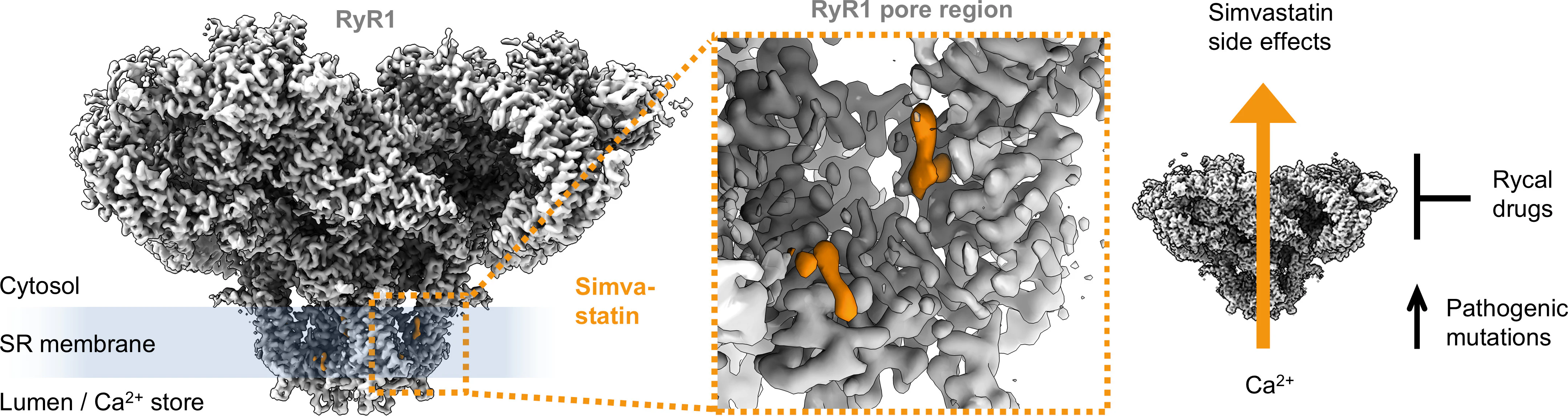
Simvastatin attaching to RyR1 in two spots. Image courtesy of Weninger et al., "Structural basis for simvastatin-induced skeletal muscle weakness..." J Clin Invest. 2025. Licensed under CC BY 4.0.
Instead of functioning like a clean “on/off” switch, the channel allows small, unwanted “leaks” or sparks of calcium to dribble into the muscle cell, even when you aren’t moving.
In normal mice (without the mutation), simvastatin didn't cause muscle weakness, in some muscles, it even slightly improved strength.
But in mice genetically engineered to carry the human-like T4709M mutation in RyR1 (a rare variant found in a patient with severe statin intolerance):
- Simvastatin caused clear muscle weakness (e.g., about a 29% drop in force in the diaphragm muscle, which helps with breathing).
- The mutation didn't cause leaks on its own under normal conditions, but it made RyR1 much more sensitive to simvastatin's effects, worsening the calcium leak.
The Counter-Drug
To test whether this leak could be prevented, the researchers used a compound called S107, a type of Rycal designed to keep RyR1 in its closed, non‑leaky state. When S107 was given together with simvastatin in the mutant mice, it completely prevented the muscle weakness.
What the Study Means
This provides strong evidence that simvastatin can directly cause muscle issues by making RyR1 leaky in certain genetically susceptible people. It doesn't explain every case of statin muscle pain (which has multiple possible causes), but it highlights why some individuals (especially those with rare RyR1 gene variants) are at higher risk.
Why Some Statins Cause More Muscle Symptoms Than Others
Now that we know statin muscle symptoms can come from calcium leaking through the RyR1 channel, it helps explain why some statins cause more muscle problems than others.
One theory: How easily a statin enters muscle tissue.
Lipophilic Statins
Examples: simvastatin, lovastatin, atorvastatin
- These dissolve easily in fat.
- Because muscle tissue contains fat layers, these statins penetrate muscle cells more deeply and in higher amounts.
- That means more statin reaches the RyR1 channel, increasing the chance of calcium leakage.
- This is why lipophilic statins tend to cause more muscle symptoms for some people.
Hydrophilic Statins
Examples: pravastatin, rosuvastatin
- These dissolve in water, not fat.
- They don’t enter muscle tissue as readily, so less drug reaches the RyR1 channel.
- This generally means fewer muscle related side effects.
This is why many clinicians switch statin intolerant patients from atorvastatin (lipophilic) to pravastatin, a hydrophilic statin that is often easier on the muscles.
Where Does Pitavastatin (Zypitamag) Fit In?
Pitavastatin is technically a lipophilic statin, but here’s the twist:
It behaves more like a hydrophilic statin inside the body.
That means:
- It enters muscle tissue far less than other lipophilic statins..
- As a result, it reaches the RyR1 channel in much lower amounts.
- So the calcium leakage and the muscle symptoms are significantly reduced.
Why Zypitamag (Pitavastatin) May Be a Better Option for Statin Sensitive Patients
Zypitamag offers several benefits that make it a strong choice for people who need statins but are sensitive to muscle side effects:
- High potency at a low dose
Zypitamag can lower LDL C by up to 45% with 4 mg, similar to much higher doses of other statins. - Less depletion of CoQ10
CoQ10 supports muscle energy. Many statins reduce CoQ10 levels, which may contribute to muscle discomfort. Zypitamag causes much smaller CoQ10 reductions, potentially improving tolerability. - Fewer drug interactions
Unlike most statins, Zypitamag is bypasses the usual CYP450 enzyme pathway, the pathway responsible for metabolizing ~80% of medications. This lowers the risk of drug drug interactions for people taking multiple prescriptions. - Gentler on blood sugar
For those with diabetes or prediabetes, Zypitamag has minimal impact on blood glucose levels compared to atorvastatin.
Statins save lives by preventing heart attacks and strokes, so if you're having muscle symptoms, don't just stop. Talk to your doctor. They can check for other causes, try a lower dose, switch statins, or add supportive options. Genetic testing or monitoring might help tailor the best choice for you.
References:
- https://www.jci.org/articles/view/194490

